 February 20, 2026
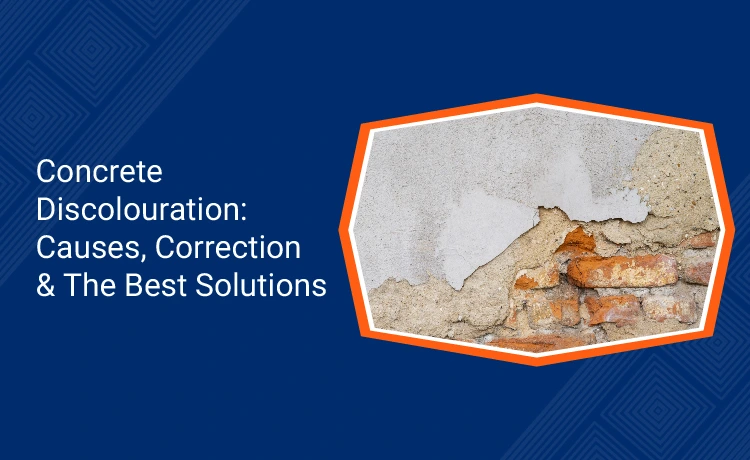
Concrete discolouration is a common yet often misunderstood issue affecting both new and existing concrete surfaces. From unsightly white patches to dark blotches and uneven tones, surface colour variations can reduce aesthetic appeal and raise concerns about material quality. Understanding concrete discolouration causes is essential for choosing the right treatment and preventing recurrence. While some forms of staining are superficial, others indicate deeper moisture or chemical imbalances within the concrete.
This guide explains why concrete discolouration occurs, how to diagnose its type, and how modern solutions, especially from MCON Rasayan, offer reliable long-term correction and prevention.
One of the most common concrete discolourations is salt migration, also known as efflorescence. Salts naturally present in cement, aggregates, water, or additives dissolve in moisture and travel to the concrete surface. When the water evaporates, white or off-white powdery deposits remain. These deposits often appear as white spots on stained concrete floors or walls and may recur unless the moisture source is controlled.
The use of calcium chloride as an accelerating admixture or as a de-icing agent can cause calcium chloride concrete discolouration. It often results in dark patches, blotchy areas, or uneven colour tones. Improper dosing, uneven mixing, or high chloride content can worsen this effect and compromise surface uniformity.
Uneven moisture distribution during curing or finishing can lead to differential hydration of cement. Excess water, rapid evaporation, condensation, or inadequate curing creates blotches, light-dark variations, and patchy colouring. This is particularly common in slabs cured without proper curing compounds or moisture retention systems.
Improper use of release agents, pigments, staining chemicals, or low-quality finishing products can also result in surface stains. External exposure to chemicals, oils, salts, and polluted rainwater further contributes to surface discolouration.
Correct diagnosis is critical before starting concrete stain removal or correction.
Understanding whether the problem is surface-level or internal helps determine whether conventional cleaning will work or whether advanced remediation is necessary.
Several traditional approaches are used for concrete stain removal, depending on severity and cause:
Low-concentration acid solutions (such as diluted muriatic acid) are commonly used for removing efflorescence and some mineral stains. While effective for surface salts, acid washing must be done carefully to avoid surface etching or weakening of concrete.
High-pressure water washing and light sandblasting can remove surface deposits and shallow stains. These methods are effective for white spots on stained concrete floors, but may not work for deep discolouration.
When stains cannot be fully removed, tinted sealers are used to mask uneven colouring and create a uniform appearance. While this improves aesthetics, it does not address the root cause.
In severe cases where stains are embedded deep into concrete, surface grinding, overlays, or resurfacing may be required. These are costly and disruptive solutions.
While these methods can help, they often provide only temporary or cosmetic correction unless the underlying chemical or moisture imbalance is resolved.
Conventional cleaning alone is often insufficient for long-term correction. Modern concrete-chemical solutions are engineered for reliability, uniformity, and durability, addressing problems at the chemical and structural level.
MCON Rasayan, a trusted Indian manufacturer of construction chemicals, offers advanced products that help prevent and manage discolouration effectively.
These curing compounds from MCON Rasayan’s concrete essentials line ensure proper moisture retention during hydration. When used correctly, they significantly reduce moisture imbalance and uneven curing, two major causes of concrete discolouration.
Proper curing prevents blotches, dark patches, and surface shrinkage cracks at an early stage.
MCON’s polymer admixtures and protective solutions help control chloride penetration, water migration, and chemical reactions within concrete.
These advanced formulations improve concrete durability, reduce internal salt movement, and enhance long-term surface appearance.
For existing discolouration, MCON’s concrete repair materials and protective coatings help restore surface integrity and prevent further staining.
With certified manufacturing facilities, documented performance, and full technical support, MCON Rasayan provides dependable, professional-grade concrete stain correction products for both prevention and remediation
Concrete discolouration is more than a cosmetic issue; it often signals moisture imbalance, chemical reactions, or improper curing. Understanding concrete discolouration causes, diagnosing the type correctly, and using the right correction strategy are essential for long-lasting results. While traditional concrete stain removal methods offer short-term relief, specialised products provide deeper and more durable solutions. With advanced curing compounds, admixtures, and protective systems, MCON Rasayan helps ensure uniform colour, structural integrity, and long-term concrete performance, making it a trusted partner for concrete correction and prevention. Contact us now!

Nandan Pradhan, a management degree holder and the Executive Director of MCON Rasayan, is the driving force behind the smooth operation of the organisation. His years of experience in planning, strategising, execution, team training, and ensuring productivity across all areas of company operations have made MCON Rasayan a global leader in the construction chemical manufacturing sector.




 08976907887
  sales@mconrasayan.com