 January 13, 2026
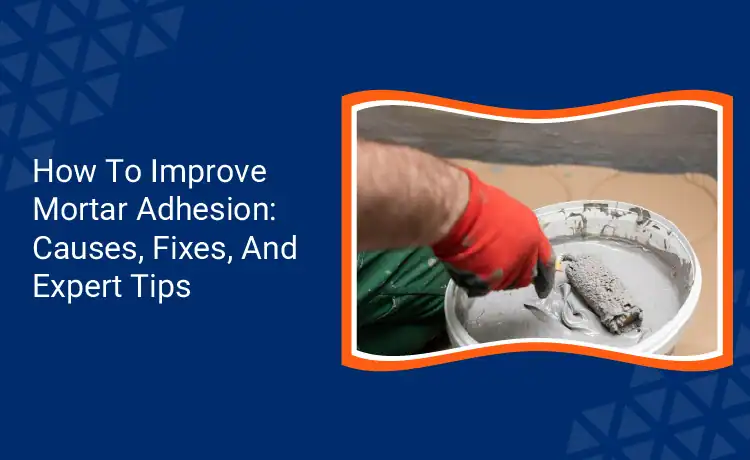
Adhesion of mortar plays an important role in the strength and lifetime of any masonry structure, whether it’s laying bricks, repairing concrete, or applying plaster. The bonding between the mortar and the substrate decides how well the surface will perform over a period of time. Poor adhesion is common, leading to cracks, delamination, moisture ingress, and structural failures. Fortunately, most adhesion failures arise from avoidable mistakes involving incorrect mixing, poor surface preparation, or environmental factors.
Here is a step-by-step guide that explains the most frequent bonding problems with mortars while describing practical solutions, expert tips, and the best mortar mixes to provide superior adhesion in every project.
Adhesion is a condition that refers to when mortar clings properly to the surfaces of brick, stone, concrete, or blockwork. Good adhesion provides strong mechanical interlock, ensures efficiency in load transfer, and provides stability to the structure over a longer period of time. It enhances water resistance by avoiding gaps or weak points that might allow moisture to seep in.
Some factors which may influence proper adhesion include substrate condition, mix proportion, curing environment, and the usage of bonding agents. Under favourable conditions of the abovementioned influence factors, mortar can achieve a durable bond with the capability to resist thermal movements, vibrations, and even weathering over time.
Probably the most common cause of a poor mortar bond is an incorrect mix ratio. Too much sand and too little cement reduce the overall bonding power of the mortar. The cement is the glue in the mix, and its correct proportioning affects bonding directly. With inappropriate proportions, the mortar starts to get brittle, crumbly, or very porous, and all those factors weaken its ability to bond well with the substrate. Ensuring the right cement-to-sand ratio is key to a strong bond.
Dust, oil, paint, moss, or efflorescence on the surface hinders proper mortar grip. On the other hand, too-smooth surfaces have very limited mechanical interlock. Cleaning of the substrate, along with slight surface roughening by tooling or a bonding coat, could enhance the bond strength substantially. An appropriately prepared surface could allow the mortar to penetrate micro-textures and thereby make a good hold.
Another major cause of weakened adhesion is rapid drying. If the mortar dries out too fast, the cement does not get enough time for hydration to occur, thus creating weak bonds that may crack early. Proper curing involves the maintenance of moisture for a recommended duration to ensure that the mortar develops its maximum strength. Light sprinkling or covering with moist burlap helps in controlling hydration.
This is one of the most common omissions made in the trade, especially when finishing over old concrete or super smooth substrates. Without a bonding layer, the new mortar can detach or not adhere well after setting.
Hot and windy weather causes premature drying, whereas cold or rainy weather delays by causing hydration and thus weakening the bond. Techniques of adjusting work timings or the application of curing compounds can minimise the effects of weather on mortar adhesion.
Bonding agents are chemicals, usually latex, acrylic, or polymer-based, that bond mortar to the base substrate. These can be added to the mix of mortar or applied on the surface as a primer before laying the mortar.
They form a sticky film, which improves the contact between new and old materials. The bonding agents improve the ability of mortars to bond with aged, smooth, or dense surfaces. Beyond this, polymers reduce shrinkage, increase flexibility, and generally improve the durability of mortar. Because of this, they become especially helpful in repair works and those areas which are subjected to vibration or thermal movement.
Applications for which bonding agents are suited include repair mortars, plastering, tile fixing, patchwork, screeding, and re-pointing. They are also very useful on aged concrete, smooth stone, or any substrate where natural suction is inadequate.
Always follow the manufacturer’s instructions for dosage and application because overuse and underuse may affect workability and bond strength.
It finds such wide usage because of its strength, availability, and versatility. The normal mix for general masonry is 1 part of cement to 4–6 parts of sand. This may be modified depending upon the structural needs of the work. A balanced mix will provide good adhesion, workability, and long-term durability.
It yields a significantly improved bonding strength that is flexible, with the addition of polymer modifiers, waterproofing compounds, and plasticisers. The additives will make it more workable, less cracked, and cohesive; hence, they will make the mortar suitable for difficult substrates or repair projects.
For uniform performance and excellent bond, a ready-mix, polymer-modified mortar should be used. Ready-mixed mortars assure consistent quality with less possibility of mixing errors and also offer superior bonding. MCON Rasayan has high-performance ready-mix mortars available in its product line.
Improper bonding usually emanates from either a mix ratio, surface preparation, curing conditions, or some environmental causes. Considering these challenges and their solutions, such as correct mix ratios, cleaning surfaces, controlled curing, and the use of bonding agents, you will see that the performance of mortars can increase significantly. Reliability can be increased with the right choice of mortar mix, especially polymer-modified or ready-mix mortars. Indeed, the best practices combined with proper materials make superior adhesion quite easily achievable.
And, for that, always choose a trustworthy construction chemicals manufacturer that provides a durable and high-quality ready-mix mortar, and MCON Rasayan excels in that. Contact us now!

Ashish Gupta is a general manager and civil engineer with over 10 years of experience in the construction chemicals industry. With his technical degree (B.Tech), extensive experience, and chemical shuffling skill, he has been responsible for executing technical solutions in areas like waterproofing, concrete repair, tile adhesive, admixtures, and protective coatings.

 08976907887
  sales@mconrasayan.com